Why We Built Edgelight: When Off-the-Shelf Lighting Systems Weren’t Enough
Production
May 8, 2026


Picture this: it's load-in for a major show, and the clock is already working against you. Cases are cracked open, gear is everywhere, and your crew is on their knees piecing together LED tape, drivers, and power supplies—soldering irons in hand, hoping every connection holds. You've done everything "right," but there's always that moment before the switch flips where you're holding your breath. Will it work? Will it look clean? Or will you be troubleshooting cables and connections minutes before rehearsal?
That was our reality at Go Live Productions—and honestly, it never felt optimal. The options on the market were clunky, inconsistent, and far more complicated than they needed to be. We weren't looking for perfection—we just wanted something reliable, modular, and clean that could actually keep up with the pace of live production. When we realized that solution didn't exist, we stopped searching and started building. That decision became Edgelight—a system born out of real-world frustration, designed by people who've lived it, and built to make stage lighting simpler, faster, and a whole lot better.
If you've ever tried to build a clean LED edge around a stage using traditional strip lighting, you know it rarely starts with one product—it starts with a shopping list. LED tape, drivers, power supplies, connectors, and cables all have to work together perfectly, and one wrong spec can send you back to square one at the worst possible time. For years, the most effective solution wasn't modular—it was fully custom: stages built with channels for LED and covered in frosted plastic. It looked great, but required significant lead time and came with high fabrication and transportation costs.
If that wasn't an option, the alternatives were limited. LED tape was fragile and often single-use, while traditional fixtures had to be placed near stage edges—exposed and difficult to conceal cleanly. At load-in, crews often found themselves doing electronics work instead of focusing on the show. After repeating this process again and again, it became clear: this wasn't just frustrating—it was a broken system that needed a modular solution.
We weren't trying to reinvent the wheel—we were looking for something that should have already existed. The list was practical: a modular LED system that could be configured for different stage sizes, clean perimeter lighting that looked intentional, secure mounting that didn't rely on tape or zip ties, and absolutely no visible cables. It had to be reliable enough to trust during a live show and fast enough to install without eating into production time.
The push toward building Edgelight came from a very specific need. A client was looking for a modular solution, but at the time, the only real option was LED being built directly into staging by staging companies—something the team had not previously dealt with in terms of LED integration.
The defining moment came during a touring project where linear LED was required around the perimeter of both carried staging and staging provided locally at each arena. To make that work, it would require a configurable, reusable, and modular LED system. At that point, the decision became clear: if the system didn't exist, it had to be built.
The team signed the contract for the tour, fully aware that it created a short window to develop a product, design and build the assets, create the packaging, and get it on the road. As one team member put it at the time, when asked what the system would be: he had no idea—but he was going to figure it out.
With input from Matt Guice, designer Tony Fransen, and technical expert AJ Morgan, the system came together quickly. Just a couple of months later, it was successfully installed at rehearsals.
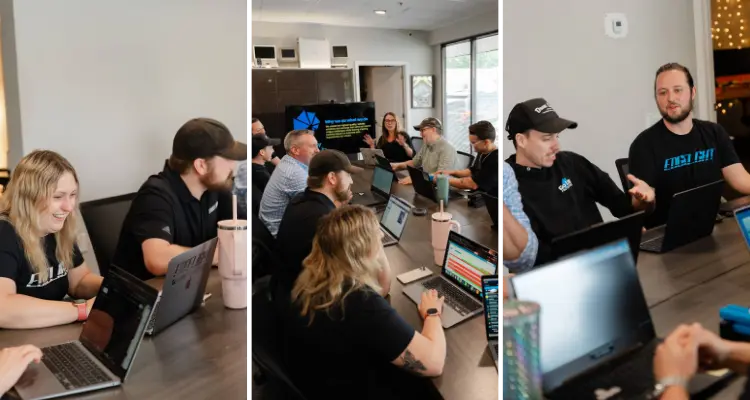
Building Edgelight required more than frustration—it required expertise. At Go Live, the team had years of experience in the entertainment field and a long-standing desire to create better processes and systems. When the opportunity came to develop a linear lighting system, those skill sets were ready to be applied.
The concept was developed internally, with key input from Matt Guice and Tony Fransen on what designers actually wanted to see in a product. AJ Morgan played a critical role in working through the technical details and hands-on development.
What truly set the process apart was the team's production experience. Having spent decades executing both large and small live events, they understood what it takes to mount a project successfully. That perspective informed a "start-to-finish" approach to design—considering how technicians would handle the system, how quickly it could deploy, and what clients ultimately expect to see in a finished installation.
Designing Edgelight started with a simple question: what would this look like if it were built the way live production actually works? The goals were clear. It had to be modular and reconfigurable, mount securely without visible hardware, set up quickly, and deliver consistent, high-quality light output while holding up to touring and repeat use.
One of the biggest advantages came from the team's extensive CAD background. While CAD was essential for design, fabrication, and even patent processes, it became even more valuable in how the system is delivered to clients. The integration of CAD documentation allows end users to input data and quickly deploy a fully integrated, pixel-driven system—something that's still fairly uncommon.
Not everything worked perfectly the first time. Early versions of Edgelight were only available in a simple RGB format, where each run of fixtures operated as a single unit. It created a strong visual look, but didn't offer the level of control designers wanted. It took nearly three years of working with suppliers to develop a proprietary LED engine capable of pixel-level control.
Progress was temporarily halted when the pandemic hit, delaying expansion into a fully digital system. About 14 months later, development resumed, and once the product launched, it quickly gained traction and has since grown significantly in popularity.
Along the way, the system continued to evolve. The development of the Flexlight series introduced the ability to create truly curved designs—something rarely achievable without custom fabrication. At the same time, refinements like truss-mounted fixtures were simplified to achieve one critical feature: being small enough to stay mounted on pre-rig truss throughout an entire tour, dramatically reducing daily labor.
There's a lot to be proud of in the product—but most of all, the team behind it.
.jpeg)
Edgelight was built around three principles: simple, flexible, and brilliant.
Simple means no tools, no soldering irons, no guesswork. Any crew member can install it correctly the first time.
Flexible is where the system opens up creatively. Because it's modular, Edgelight scales from tight breakout rooms to full arena builds, with options that support both straight and curved designs.
Brilliant isn't just about brightness—it's about execution. Light output is clean, consistent, and camera-friendly, with integrated power, data, and cable management that keeps installations looking as polished as they perform.
Edgelight's first installation came during the Rock and Worship Roadshow tour, with production rehearsals at the Steel Mill in Nashville. At that point, the client hadn't fully seen what the team had been developing, but trusted them to deliver something suitable.
That trust paid off. When the team rolled in with the first road cases and began installing, there was an immediate reaction. What they saw was a roadworthy system that worked exactly as designed. It was a proud moment—the culmination of months of long hours and pressure to deliver a viable product.
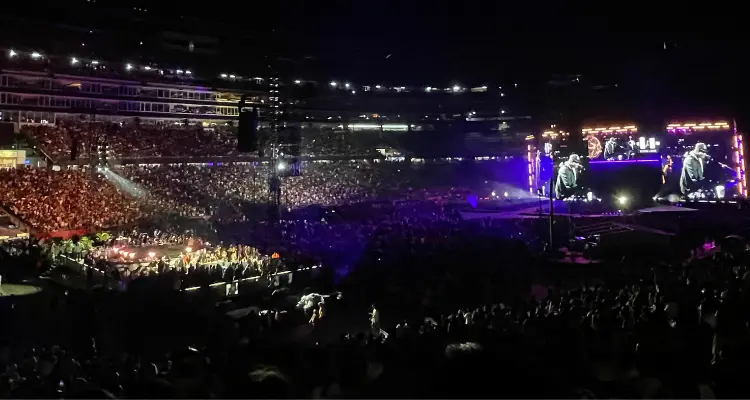
Since then, Edgelight has allowed countless productions that would have never had the time or budget to outline stages and structures in LED to include that level of detail. It's been used across tours, corporate events, award shows, trade shows, theatrical productions, sporting events, and more.
.jpeg)
The impact is immediate. "Wow" is a common reaction. In many cases, designers and clients note that among all the high-end lighting and video elements on a show, Edgelight can be one of the most visually impactful.
Operationally, it's also changed the way productions are executed. Innovations like truss-mounted fixtures that stay in place throughout a tour have become a game changer for labor—allowing crews to simply connect truss sections instead of installing and striking fixtures daily. Meanwhile, the Flexlight series has opened the door for curved, more dynamic designs without requiring custom fabrication.
Edgelight represents more than a lighting system—it reflects how Go Live approaches every challenge. It's about refusing to accept complexity as the default and building tools that actually serve live production.
Production companies have a unique advantage when it comes to innovation. They understand the pressure of load-ins, tight timelines, and what failure looks like mid-show. Solutions are tested in real environments, refined through real feedback, and built for reliability—not just features.
Edgelight is offered through Go Live Productions as part of full production services, integrated directly into event design, planning, and execution. It can be specified during pre-production as part of lighting design or included within a complete production package.
It excels at outlining stages, scenic elements, truss, and architectural features across a wide range of events. Because it's modular and scalable, it adapts from intimate setups to full arena builds without changing the workflow—resulting in faster installs, fewer failure points, and a cleaner final product.
At Go Live Productions, when off-the-shelf doesn't meet the demands of live production, they build something better. Edgelight is the result of that mindset—developed under real pressure, for real shows, by a team that understands what's at stake.
Want to see Edgelight in action? Let's talk about how it can transform your next event.
Copyright © Edgelight. All Rights Reserved.